2007 Spring Symposium
Johnathan E. Holladay,* James F. White, John G. Frye, Alan Zacher, and Todd Werpy
Pacific Northwest National Laboratory
Richland, WA 99337 (USA)
*john.holladay@pnl.gov
Abstract — Advances in catalysis are important endeavors to empower biorefineries and the use of renewable feeds. This paper presents the development of effective catalysts for aqueous phase processing. The focus of the work will be of hydrogenation and hydrogenolysis and will include examples of upgrading of sugar alcohols (sorbitol and glycerol) and fermentation products such as amino acids and diacids into chemical products.
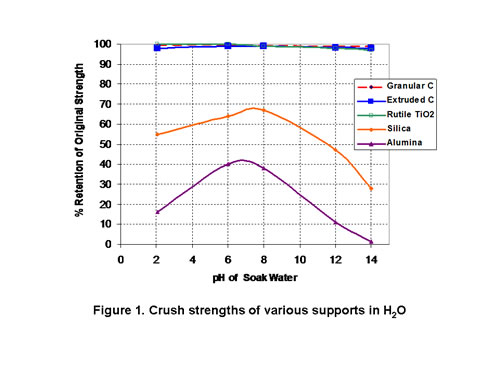
Choice of support has a tremendous impact on catalysis performance and stability. We have shown granular and extruded carbon supports to be particularly stable to hydrothermal conditions as measured by crush strength versus silica or alumina supports (see Figure 1). Rutile Titanium has also shown high strength. Granular carbons have a very different pore structure than carbon extrudates which can impact catalyst performance.
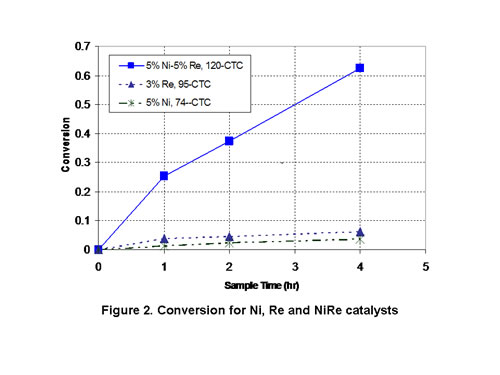
In the example of upgrading of sugar alcohols the support plays a role on selective adsorption of reagents and products. In addition to the support, the interactions between nickel and rhenium play a pivotal role in the catalyst. An extreme example of the reactivity difference is shown in Figure 2 (batch conditions, 200 °C, 1200 psig H2). In addition to nickel and rhenium we will also discuss results with silver, copper, and ruthenium. Finally, using two additional systems we will highlight general technical challenges drawn from our work with fermentation products.