2007 Spring Symposium
Jaime R. Blanton1*, Takuma Hara2, Konrad Möbus3 and Baoshu Chen3
1Degussa Corporation,5150 Gilbertsville Highway, Calvert City, KY 42029 (USA)
2Degussa Japan, Tsukuba Minami Daiichi Kogyo Danchi, 21 Kasuminosato Ami-machi, Inashiki-gun Ibaraki-ken 300‑0315 (Japan)
3Degussa Ag,Rodenbacher Chaussee 4, 63457 Hanau-Wolfgang (Germany)
*jaime.blanton@degussa.com
Abstract — ε-caprolactam is a feedstock for nylon-6 polymers. The demand for ε-caprolactam was 4 million metric tons in 2005. Hydroxylamine (hyam) is a key raw material for the manufacture of ε-caprolactam. The hydroxylamine used in the HPO™ is produced by selective hydrogenation of nitric acid over a Pd/C catalyst. Degussa has done extensive work to develop Pd/C catalysts with superior activity for the production of hyam (Equation 1).
Equation 1: NO3− + 3H2 + 2H+ → NH3OH+ + 2H2O
Many parameters influence the performance of a catalyst. Our aim was to see how varying the carbon support, Pd loading and Pt addition would affect the activity, selectivity and filterability of the catalyst in hopes of identifying the optimal catalyst for the hyam reaction (activity greater than 25 g hyam/g Pd, selectivity >; 90% and fast filtration rate).
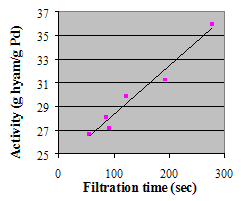
Numerous catalysts were prepared by several different methods and tested for their hyam activity. Catalysts (six in total; A-F) prepared using the method that provided the most active catalysts were used in this study. These catalysts were each prepared by the same proprietary procedure and each contains 10% Pd except D which contains 9% Pd. In a typical test 750 mg of catalyst was added to a continuous stirred tank reactor (1500 rpm) containing the nitrate ions in 1L of phosphate buffer solution. The amount of hyam formed and selectivity after 90 min at 30 °C were measured by titration. Catalyst filtration rates were measured by passing a slurry of buffer solution containing 5 g catalyst through a filter cloth at 0.1 MPa N2 pressure.
From this study it is evident that several highly active hyam catalysts have been developed for the HPO™ process. Depending on which performance indicator is most important (activity, selectivity or filterability) one can select the best Degussa catalyst for their application.
Table 1: Activity (g hyam/g Pd) and selectivity for bimetallic catalysts and catalysts of varying Pd loadings.
| Cat. Type | % Pd | % Pt | Activity | Selectivity |
|---|---|---|---|---|
| A | 9 | 0 | 37.2 | 100 |
| A | 10 | 0 | 36.0 | 95.7 |
| A | 12 | 0 | 32.7 | 94.6 |
| A | 15 | 0 | 28.9 | 98.0 |
| C | 12 | 0 | 27.7 | 93.2 |
| C | 12 | 0.1 | 30.7 | 92.3 |
| A | 12 | 0.1 | 35.0 | 93.3 |
| A | 8 | 2 | 57.3 | 86 |
Figure 1: Hyam activity vs. filtration of catalysts.